
外研社版-七下-03.Unit 1 The secrets of happiness Developing ideas


Unit 1 The secrets of happiness Developing ideas 试讲稿
Good morning, dear judges! I'm [no.1], and I'm honored to present my teaching
demonstration. Now, let's embark on this exciting English - learning journey.
I. Warm - up and Introduction
Good morning, boys and girls. How are you today Fine, great, not bad Wow, I’m
pretty well. Thanks for your asking. Now are you ready for our English travel Good.
Let's start our class with some interesting pictures on the screen. Here we have
people playing, spending time with their loved ones, and achieving their goals. Now,
I have two questions for you. First, "What do you see in these pictures?" The boy in
the front row, raise your hand and share your view.
Student: I see people having fun and enjoying themselves.
Teacher: Great observation! And how do you think these people feel? The girl with
pigtails.
Student: They look happy and excited.
Teacher: Exactly! I'll write down your answers on the board. Now, I want to write
"Happiness" on the board. What makes you happy? The boy in the blue shirt, would
you like to share?
Student: Playing basketball makes me happy.
Teacher: Basketball is a great sport! It's wonderful that it brings you happiness.
Today, we'll explore the secrets of happiness and how different people find it in
various ways.
II. Vocabulary and Phrase Introduction
Now, it's time to learn some new and important vocabulary. Look at the board. We
have "happiness", "joy", "contentment", "satisfaction", "gratitude", and "emotional
well - being". Let me explain them to you. Happiness is the state of being happy or
feeling joy. Joy is a great feeling of happiness or delight. Contentment is the state of
being satisfied and at peace. Satisfaction is the feeling of contentment when one’s
desires are fulfilled. Gratitude is a feeling of thankfulness or appreciation. Well -
being is the state of being comfortable, healthy, or happy.
For example, "I feel content when I spend time with my family." Now, repeat after
me. "Content".
Students: Content.
Teacher: Very good. Let's do an activity. I've written the vocabulary words on the
board and their definitions on slips of paper. Please come up and match each word
with the correct definition. The first student who raises their hand can come.
(Assume the student is matching)
Teacher: Well done! Now, everyone, make sentences with each vocabulary word.
The girl wearing glasses, can you use "gratitude" in a sentence?
vx:
nsywk01
Student: I express my gratitude to my parents for their love.
Teacher: Excellent! You used the word perfectly.
III. Listening and Speaking Activity
Next, we'll do a listening and speaking activity. Listen carefully to a short video of
people talking about what makes them happy.
(Play the video)
Now, can you answer these questions? What makes people happy in the video? The
girl in the yellow T - shirt.
Student: In the video, spending time with family, helping others, and achieving goals
make people happy.
Teacher: Right! And do you agree with them? Why or why not? The boy with glasses.
Student: I agree because spending time with family also makes me happy. It gives
me a sense of belonging.
Teacher: Well - thought! Now, pair up with your deskmates. Discuss these questions:
"What makes you happy?", "Do you think happiness is the same for everyone?", and
"What are the best ways to be happy?" Use the new vocabulary words in your
discussions. Start now.
(After a while)
Okay, let's stop. Which pair wants to share your answers? The first pair, please.
(Assume the pair is sharing)
Teacher: Great! You both had some really good points and used the vocabulary very
well.
IV. Grammar Focus – Comparative and Superlative
Forms
Now, let's focus on grammar, specifically the comparative and superlative forms of
adjectives. Look at the board. We have "happy, happier, the happiest". For example,
"I am happier when I spend time with my friends." This is the comparative form. And
"Spending time with my family is the happiest moment of my day." This is the
superlative form. Now, work in pairs to create sentences using these forms. You can
also use other emotion - related words like “joyful,” “excited”. Start.
(After a while)
Okay, let's stop. Which pair wants to share your sentences? The second pair.
(Assume the pair is sharing)
Teacher: Wonderful! You both used the comparative and superlative forms
correctly.
V. Reading and Critical Thinking
vx:
nsywk01

相关推荐
-
道德法制一年级上册-统编版《02.我向国旗敬个礼》试讲逐字稿

 2026-03-06 12
 -
小学道德法制《交通与生活》试讲逐字稿【免费质量一般】
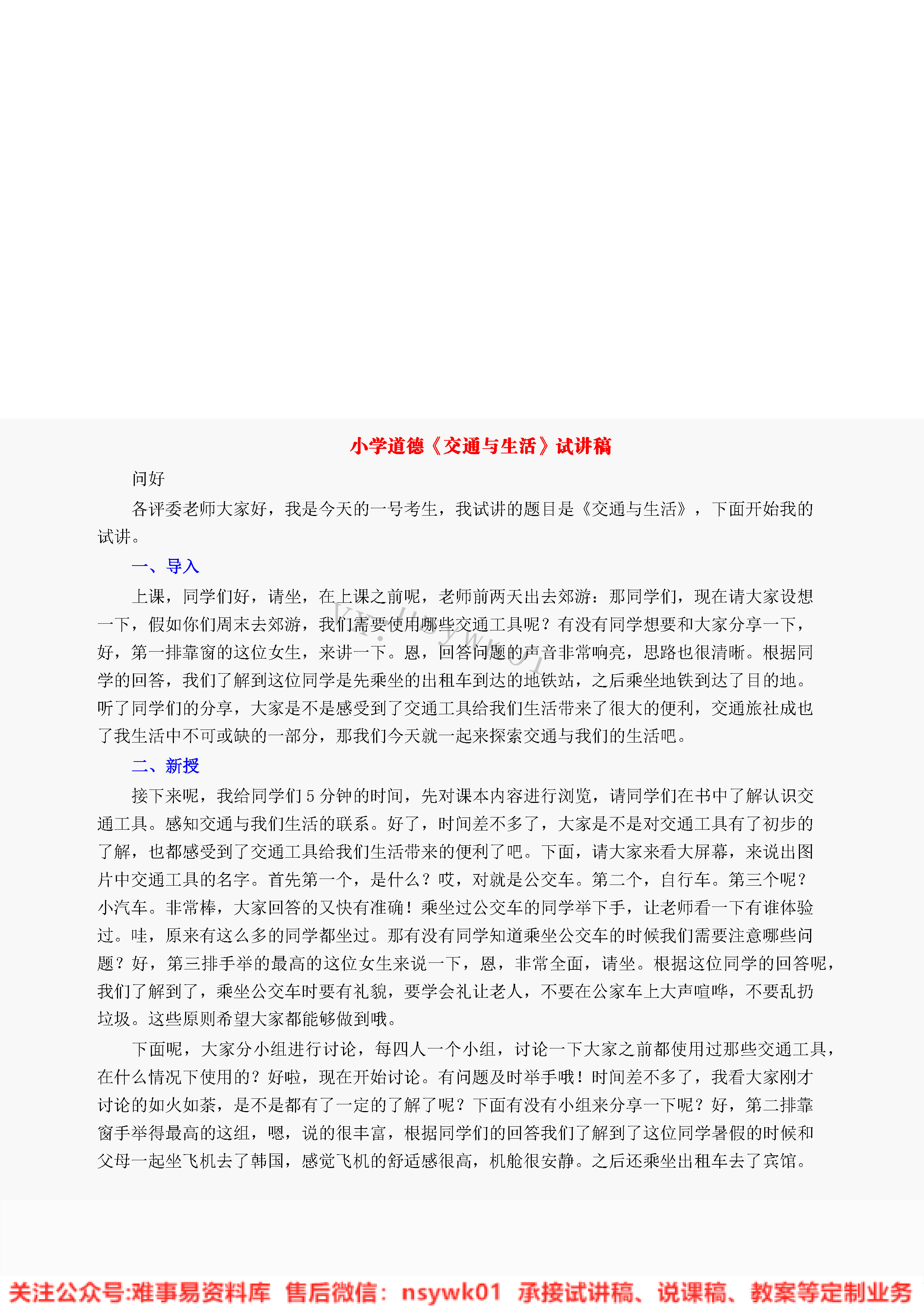 2026-03-06 10
 -
小学道德法制《呵护我们的身体》试讲逐字稿【免费质量一般】
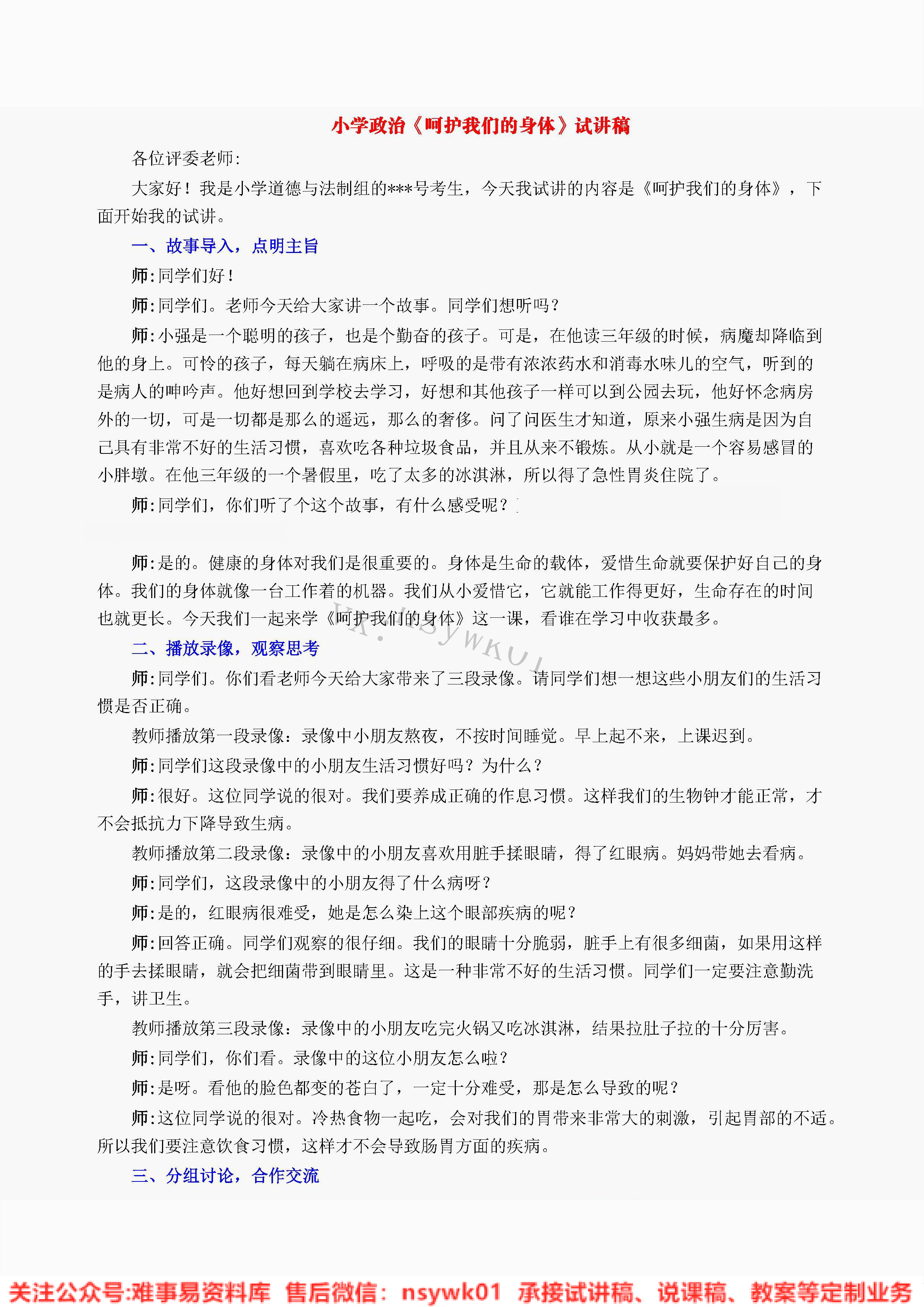 2026-03-06 8
 -
小学道德法制《我们的公共生活》试讲逐字稿【免费质量一般】
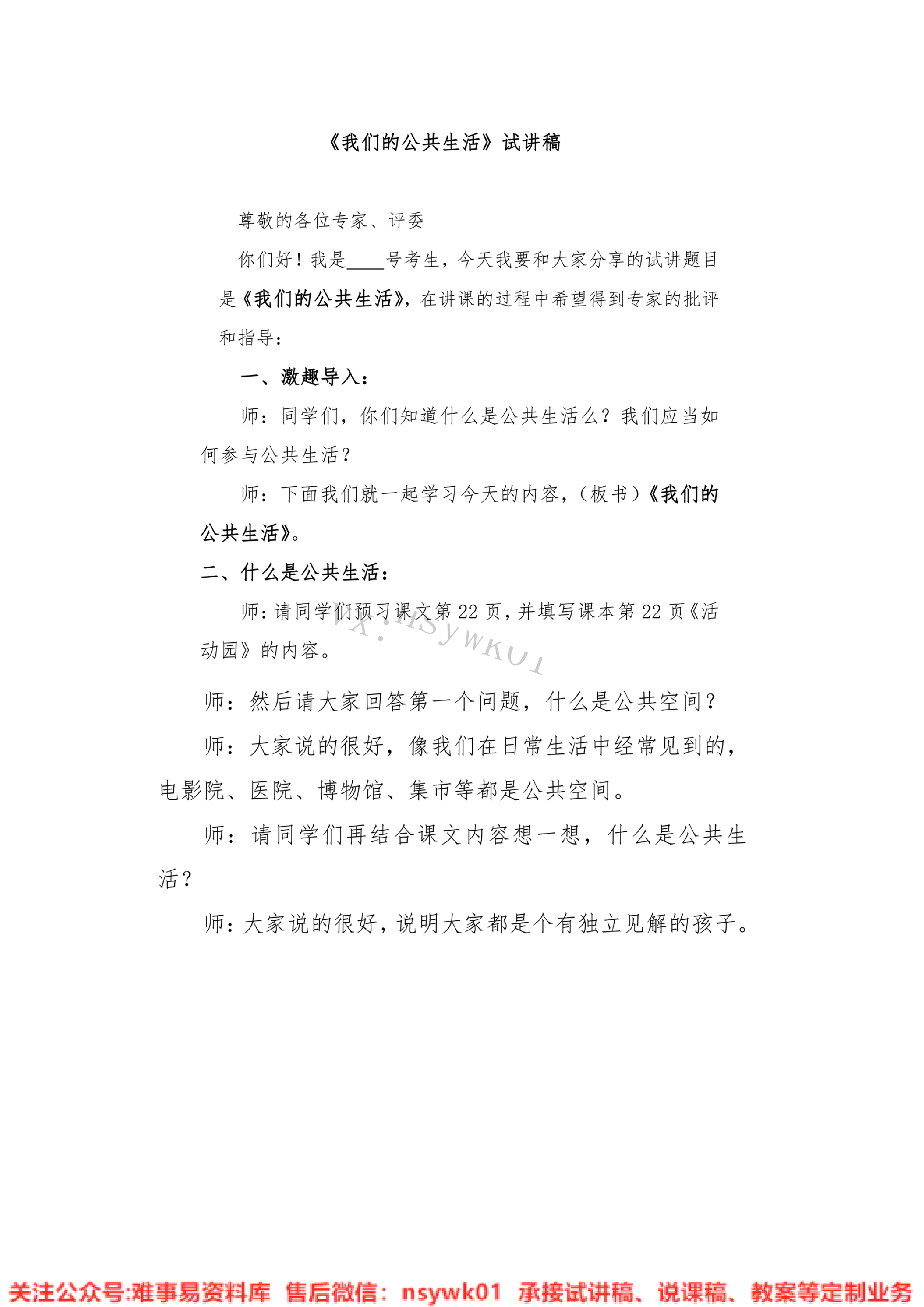 2026-03-06 11
 -
小学道德法制《健康的生命最美丽》试讲逐字稿【免费质量一般】
 2026-03-06 9
 -
小学道德法制《平安回家》试讲逐字稿【免费质量一般】
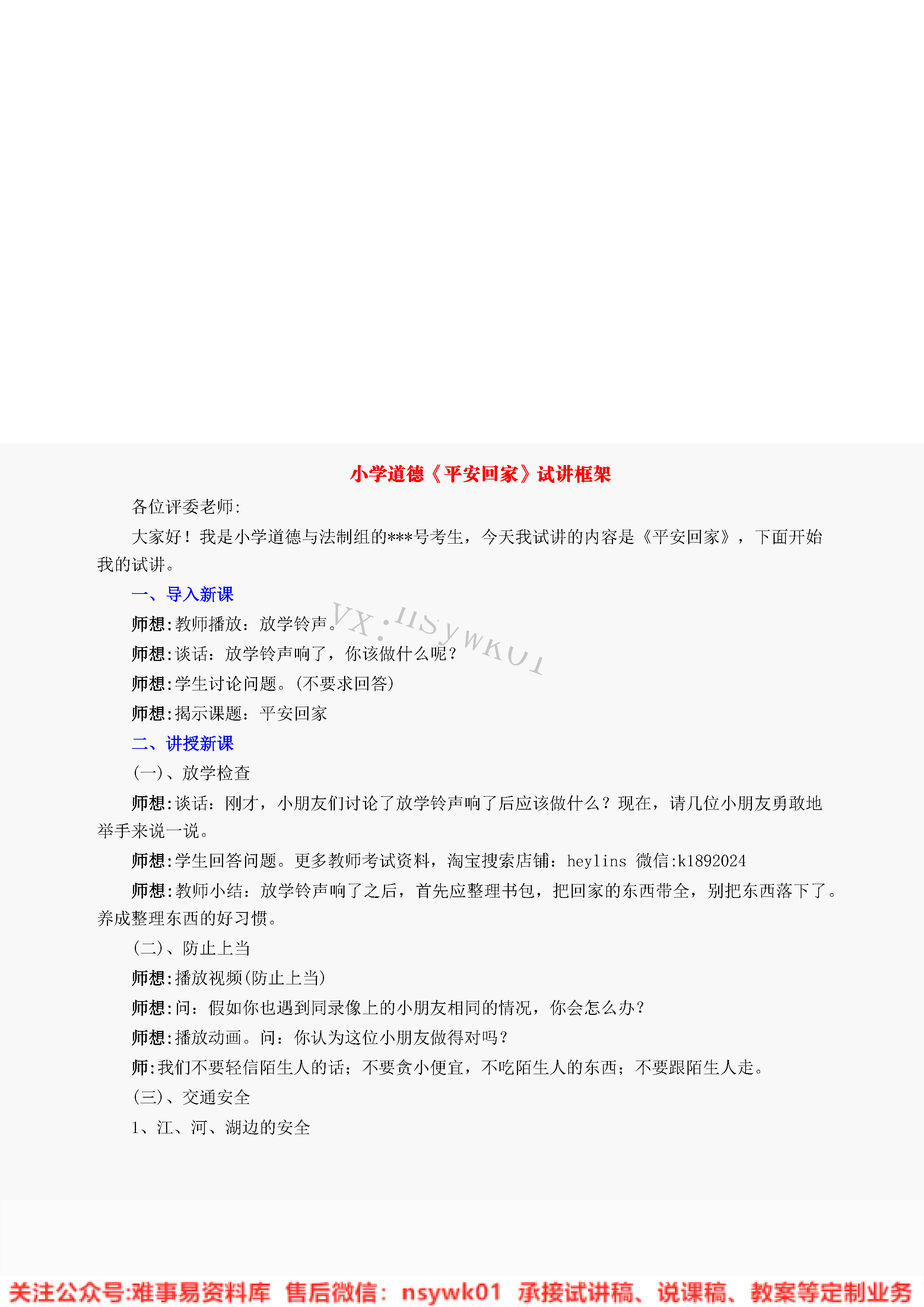 2026-03-06 10
 -
小学道德法制《魅力文字中华瑰宝》试讲逐字稿【免费质量一般】
 2026-03-06 9
 -
小学道德法制《课程伴我成长》试讲逐字稿【免费质量一般】
 2026-03-06 12
 -
小学道德法制《我家门前新事多》试讲逐字稿【免费质量一般】
 2026-03-06 11
 -
小学道德法制《让我们的家更美好》试讲逐字稿【免费质量一般】
 2026-03-06 13
作者:农村人丶高调上...
分类:初中
价格:2.9难事币
属性:4 页
大小:633.76KB
格式:PDF
时间:2026-09-15
作者详情


相关内容
-

道德法制六年级下册-统编版《01.学会尊重》试讲逐字稿
分类:小学
时间:2026-03-06
标签:无
格式:PDF
价格:2.9 难事币
-

道德法制六年级下册-统编版《02.学会宽容》试讲逐字稿
分类:小学
时间:2026-03-06
标签:无
格式:PDF
价格:2.9 难事币
-

道德法制六年级上册-统编版《03.权力受到制约和监督》试讲逐字稿
分类:小学
时间:2026-03-06
标签:无
格式:PDF
价格:2.9 难事币
-
道德法制五年级上册-统编版《03.学会沟通交流》试讲逐字稿
分类:小学
时间:2026-03-06
标签:无
格式:PDF
价格:2.9 难事币
-
道德法制二年级下册-统编版《04.小水滴的诉说》试讲逐字稿
分类:小学
时间:2026-03-06
标签:无
格式:PDF
价格:2.9 难事币


